Solid hardwood flooring guide covering real costs, Janka hardness, pros and cons, the rooms it’s actually good for, and mistakes to avoid before you buy.
Published: August 20, 2026 Reading time: 7 minutes
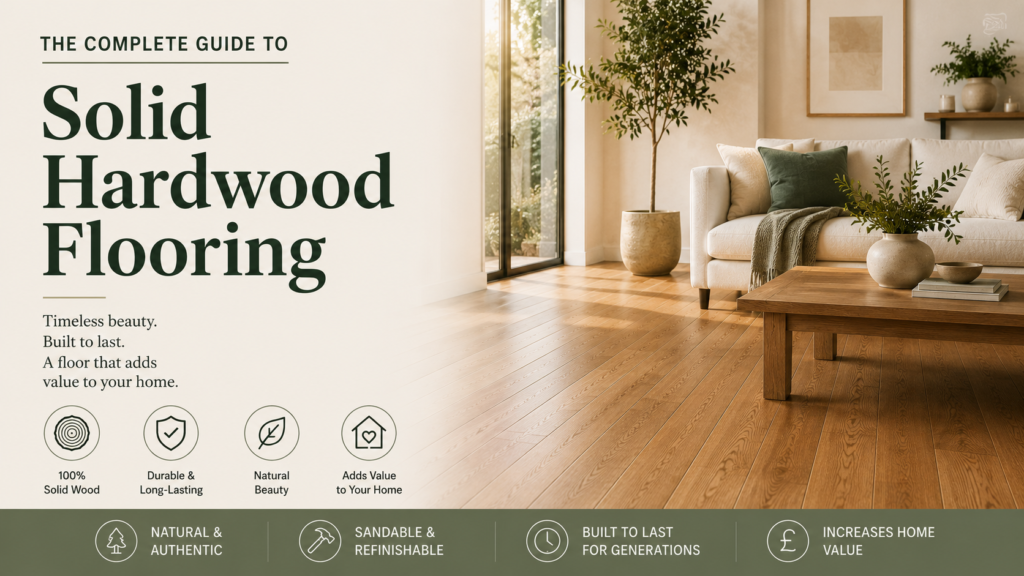
Welcome to our Solid Hardwood Flooring Guide
Solid hardwood is the flooring equivalent of a cast-iron skillet: it’s pricier than the alternatives, a little precious about moisture, and, you’re kind of buying it for your grandkids too.
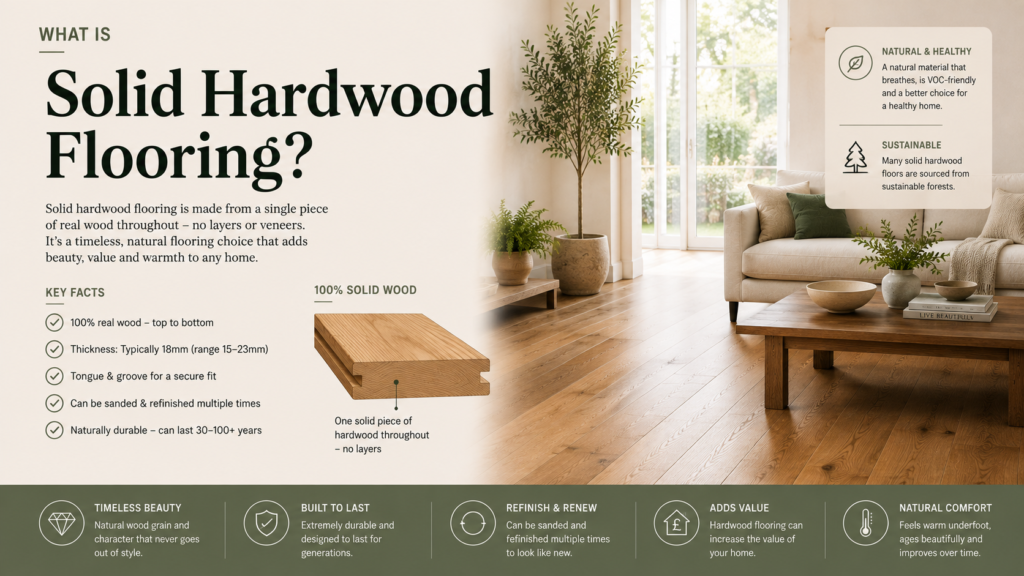
Unlike laminate or vinyl, there’s no photo layer doing the wood impression here — it’s real timber, top to bottom, which means it can be sanded back and refinished again and again for decades instead of ending up in a skip the moment it gets scratched.
That’s the whole pitch.
It’s also why it costs more and demands a bit more respect during fitting. This guide covers what it really costs, what it’s made of, where it belongs in your home (and where it very much doesn’t), and the mistakes that turn a “grand hallway floor” dream into an expensive gap-filled cautionary tale.
How Much Does Solid Hardwood Flooring Cost?
Budget tier: £45–£60/m² — narrower boards, “character” or “rustic” grade (more knots and colour variation, nothing wrong with it, just busier to look at)
Mid-range: £60–£90/m² — the sweet spot for most homes; select or prime grade oak in a sensible width
Premium: £90–£150+/m² — wide plank boards, walnut or other specialty species, herringbone and chevron patterns
If you’re hiring a fitter (which, more on that in a minute, you probably should for this one), add roughly £25–£60/m² in labour for secret-nailing or glue-down installation.
Example: for a 4m × 4m room (16m²), you’re looking at roughly £960–£1,440 in materials at mid-range, plus £400–£960 in professional fitting if you don’t DIY it — call it £1,360–£2,400 all-in for a proper fitted solid oak floor. A confident, patient DIYer can shave the labour cost off, but budget extra time, not just extra elbow grease.
Extra costs to factor in: a damp-proof membrane or underlay if you’re glue-down or floating (£5–£15/m²), skirting or beading to finish the edges (£5–£12 per linear metre), and subfloor prep if your existing floor isn’t flat and dry (£10–£40/m²).
What Actually Makes One Solid Hardwood Floor Different From Another
With vinyl, the number that matters is wear layer thickness. With solid hardwood, it’s the Janka hardness rating — a measure of how much force it takes to dent the wood. This is the spec that tells you whether a floor can survive a Labrador and two toddlers, or whether it’s better suited to a quiet guest room.
- Oak (European or White): ~1,290–1,360 lbf — the reliable all-rounder, and the reason most solid wood floors in the UK are oak
- Ash: ~1,320 lbf — similarly tough, lighter and more contemporary in tone
- Maple: ~1,450 lbf — one of the hardest common options, good for heavy traffic
- Walnut: ~1,010 lbf — beautiful, expensive, and noticeably softer, so treat it gently in busy rooms
Boards are typically 18–20mm thick, which is what allows solid hardwood to be sanded and refinished multiple times over its life — usually 4 to 6 times before the boards get too thin to safely sand again. That’s the entire reason people pay more for this over engineered or laminate: you’re not replacing the floor when it gets tired, you’re refreshing it.
Longevity & Maintenance
A well-installed, well-maintained solid hardwood floor can realistically last 25 to 100+ years — plenty of period homes still have their original boards. Plan on sanding and refinishing roughly every 7–10 years depending on traffic, sunlight, and how many people are sliding chairs across it.
Day-to-day care is simple but non-negotiable:
- Use a proper wood floor cleaner, applied dry or barely damp — never a wet mop and absolutely never a steam mop
- Felt pads under every piece of furniture, no exceptions
- Rugs in high-traffic paths and in front of the sofa
- Keep indoor humidity reasonably stable — solid wood expands and contracts with the seasons, and that’s normal, not a fault
- Blinds or curtains to limit direct sun on one section, which can bleach it unevenly over time
Pros and Cons of Solid Hardwood Flooring
Strengths:
- Can be sanded and refinished multiple times — it’s the floor that fixes its own scratches
- Genuinely adds resale value; buyers respond to “real wood” in a way they don’t to “wood-look”
- Ages into a patina rather than just wearing out
- Long lifespan when looked after
- That solid, warm, slightly creaky underfoot feel that vinyl and laminate can’t fake
Weaknesses:
- Not waterproof — spills need wiping up promptly, and it’s a poor match for anywhere genuinely wet
- The most expensive common flooring option, materials and fitting both
- Moves with humidity and temperature — small seasonal gaps are normal, not a defect
- Harder to DIY than click-together flooring; nailing or gluing solid boards is a different skill level to clicking LVT together in an afternoon
- Needs an acclimatisation period (boards left in the room, usually 1–2 weeks, before fitting) — you can’t just buy it and lay it the same weekend
Best Rooms for Solid Hardwood Flooring
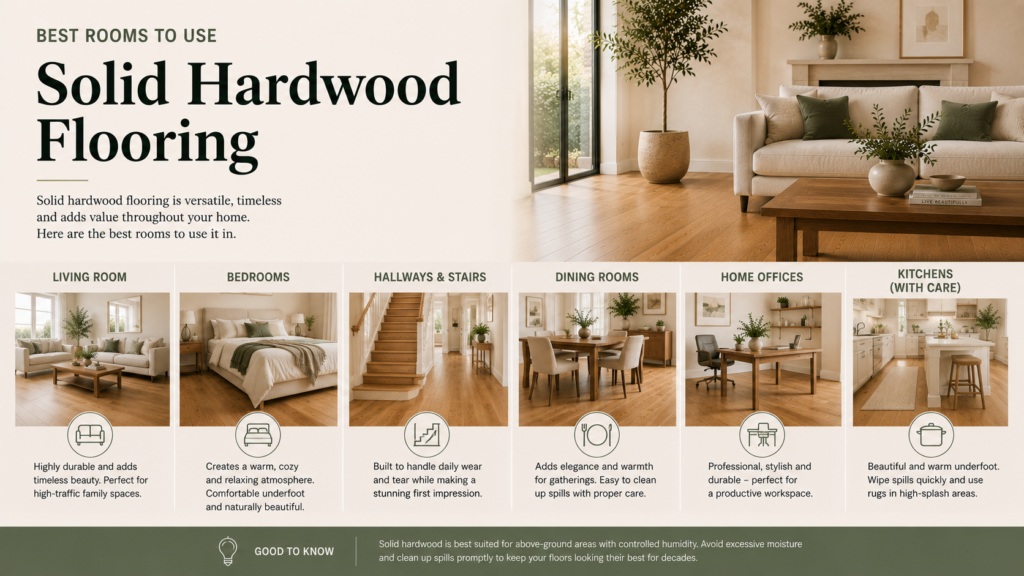
Living rooms, dining rooms, bedrooms, and hallways (with a decent doormat to catch the grit) are where solid hardwood earns its keep. Anywhere dry, with reasonably stable humidity, is fair game.
Skip it in bathrooms, utility rooms, and cellars or basements — the moisture risk isn’t worth it, and this is exactly the situation luxury vinyl was built for instead. Also check before you commit to underfloor heating: many solid hardwood floors aren’t rated for it because the wood moves too much with the heat cycling, and you’ll need engineered wood instead. If you’re not sure which category you’re in, our flooring calculator and our engineered hardwood guide are good next stops.
A Solid Hardwood Product Worth a Look
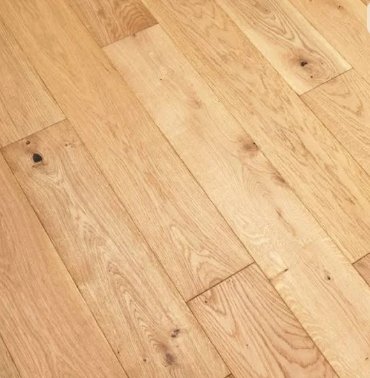
Classic Oak Plank, Brushed & Oiled – 125mm x 18mm Solid Wood
£47.99•Floor Warehouse
Classic Oak Plank, Brushed & Oiled – 125mm x 18mm Solid Wood Flooring is a good example of the kind of solid hardwood worth considering if you want genuine timber without moving into the very top end of the price range. It is 18mm thick, 125mm wide, solid oak and brushed & oiled, giving you the natural grain and character that make real hardwood so appealing. The current listed price is around £47.99/m², although flooring prices can change.
The big advantage of solid oak is longevity: unlike laminate or vinyl, solid wood can be sanded and refinished multiple times over its life, allowing you to refresh the surface rather than replace the entire floor. Just remember that solid hardwood isn’t suitable for every room — moisture and humidity need to be controlled, and this type of flooring generally isn’t suitable over underfloor heating.
💡 Tip: Order a sample before buying the full floor. Natural oak can look noticeably different in your home depending on the light and surrounding colours.
Quick features to highlight once you’ve picked one:
- Species and Janka hardness
- Board thickness and width
- Finished vs unfinished (unfinished = sanded and sealed on site for a seamless look, more work; finished = ready to walk on faster)
- Tongue-and-groove profile for secret nailing or glue-down
- Price per m²
Getting the Numbers Right
Before you order a single board, run your room through our flooring calculator to get an accurate board count. Solid hardwood is unforgiving of under-ordering — batches (and even individual trees) vary slightly in colour, so topping up later can leave a visible mismatch. Measure the room, add your waste allowance (around 10% for straight-laid boards, more like 15–20% for herringbone or chevron), and check your subfloor is flat, dry, and structurally sound before it arrives.
Common Mistakes
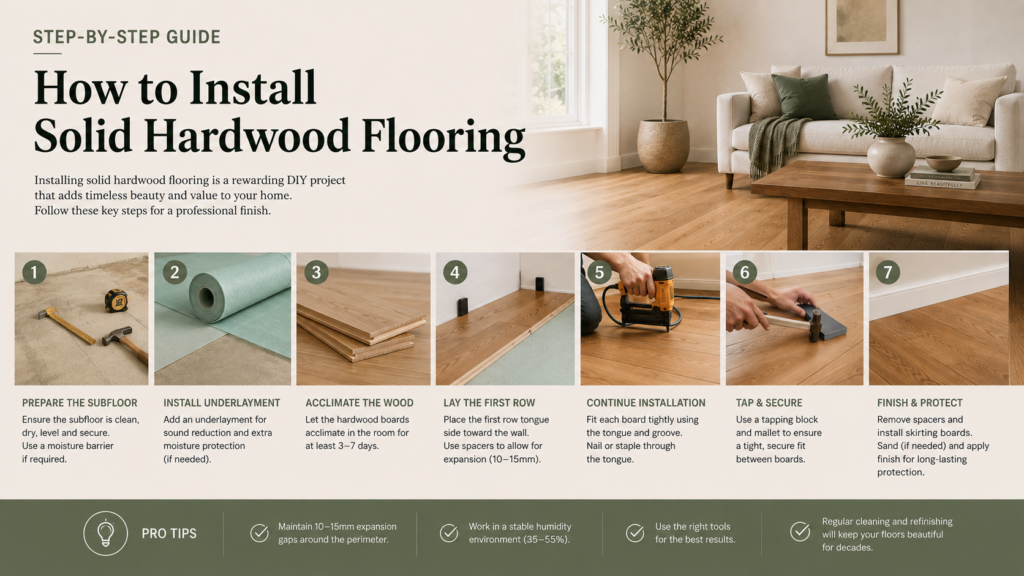
- Skipping the acclimatisation period. Solid wood needs to sit in the room it’s being fitted in, ideally for 1–2 weeks, so it adjusts to the local humidity before it’s nailed or glued down. Skip this and you risk gaps or buckling later.
- Not checking the subfloor’s moisture level. Solid hardwood needs a genuinely dry, stable base. A moisture meter is a cheap way to avoid an expensive problem.
- Fitting it somewhere it doesn’t belong. Bathrooms, wet utility rooms, and unrated underfloor heating setups are where solid hardwood goes to have a bad time.
- Forgetting the expansion gap. Wood moves. Leave the gap around the perimeter that the manufacturer specifies, and let the skirting or beading hide it — don’t fit the boards edge-to-edge with the wall.
- Cleaning it like it’s vinyl or tile. Steam mops and heavy wet mopping are how a beautiful solid wood floor turns into a cupped, warped one. Dry or barely-damp cleaning only.
Pre-Purchase Checklist
- Measure the room and run it through the flooring calculator for an accurate board count plus waste allowance
- Confirm the room suits solid wood — no persistent damp, no direct exposure to standing water
- Match the species’ Janka hardness to your actual traffic level (pets and kids, be honest)
- Decide your fitting method — secret-nail, glue-down, or hiring a professional — before you order
- Build acclimatisation time into your schedule; boards need to arrive at least a week or two before fitting day
- Check underfloor heating compatibility if you have it, and confirm with the manufacturer if in doubt
Recommended Products
- Damp-proof membrane/wood flooring underlay — non-negotiable moisture protection between your subfloor and your very expensive new floor
View on Amazon→ - Flooring installation kit or secret-nailing kit (nailer/stapler, spacers, pull bar, tapping block) — the difference between a smooth install and a long weekend of regret
View Installation Kit on Amazon→
View Flooring Nailer/Stapler on Amazon→ - Tape measure — for accurate room measurements before you order a single board
View on Amazon→ - Wood floor threshold/transition strip — for doorways and where the wood meets another flooring type
View on Amazon→ - Wood floor cleaner and maintenance oil or wax matched to your floor’s finish — not a vinyl or laminate cleaner; they’re not interchangeable
View on Amazon→
As an Amazon Associate, we may earn from qualifying purchases. This doesn’t affect the price you pay.
Related Reading
Not sure solid hardwood is the one? Compare it against our luxury vinyl guide for anywhere near water, or check out engineered hardwood if you love the wood look but want underfloor heating or an easier DIY fit.
Subscribe to the newsletter for more one-room-at-a-time DIY guides — no experience required, just mild bravery.