Best Laser Levels for DIY: 7 Top Picks Compared (2026)
Finding the best laser level can save you hours of measuring and help you achieve professional-looking results, even if you’ve never tackled a DIY project before. After comparing today’s most popular models, we’ve selected the best laser levels for different budgets and jobs.
Intro
I’ll be honest… for years I thought laser levels were one of those fancy tools that only builders used.
Turns out, I couldn’t have been more wrong.
The first time I tried putting up floating shelves, I stood back feeling ridiculously proud of myself… until I noticed one side was noticeably higher than the other. Once you see it, you can’t unsee it. Every time I walked past, those shelves silently judged me.
If you’ve ever hung a picture that somehow looks crooked even though you swear you measured it, or laid flooring only to realise things aren’t lining up quite as planned, you’re definitely not alone.
A laser level takes all the guessing out of it. It projects perfectly straight lines across your room, making jobs quicker, easier and—most importantly—far less frustrating.
I compared some of the best laser levels you can buy right now, whether you’re decorating one room or planning a full house makeover.
Let’s find the one that’s actually worth spending your money on.
In a Hurry?
If you’re short on time, here’s the quick version:
🥇 Best Overall: Bosch UniversalLevel 360
💰 Best Budget: Stanley Cubix
👷 Best Professional: DeWalt Green Cross Line Laser
🏡 Best for Home DIY: Huepar 360
Keep reading for the full comparison, what the features actually mean, and which one is worth your money.
Comparison Table
| Laser Level | Best For | Self Levelling | Range | Price |
|---|---|---|---|---|
| Bosch UniversalLevel 360 | Best Overall | ✅ | 24m | ££ |
| Huepar 360 | Best Value | ✅ | 30m | ££ |
| Stanley Cubix | Beginners | ✅ | 12m | £ |
| DeWalt Green | Professionals | ✅ | 30m | £££ |
| Leica Lino | Premium | ✅ | 35m | ££££ |
How I Chose These Laser Levels
I didn’t just pick the most expensive ones and call it a day.
When comparing each laser level, I looked at the things that actually matter when you’re using it around the house:
- Accuracy
- Ease of use
- Brightness of the laser
- Battery life
- Build quality
- Value for money
- Real customer reviews
Because let’s be honest… nobody wants to spend £200 on a tool they’ll use twice.
The 3 Best Laser Levels
1. Bosch UniversalLevel 360 – Best Overall ⭐
Best for: Homeowners tackling all kinds of DIY projects.
If you’re only planning to buy one laser level, this would probably be my pick.
It’s accurate, incredibly easy to use, and the 360° laser line makes jobs like laying flooring or fitting kitchen cabinets so much easier because you don’t have to keep moving the tool around.
Pros
✅ Bright laser
✅ Self-levelling
✅ Trusted brand
✅ Great build quality
Cons
❌ Slightly more expensive than entry-level models
2. DeWalt DW088CG-XJ – Best for Serious DIY Projects
Best for: DIYers who want something tough and reliable that will survive more than one renovation.
If you’re the sort of person who says “I’m only doing the kitchen” and then somehow ends up renovating half the house… this is probably the one for you.
The DeWalt is built more like a proper worksite tool than a little gadget you’ll be nervous about dropping. It has a green laser, which is much easier to see than red in bright conditions, and it’s self-levelling, so there’s no faffing around trying to get the line perfectly straight yourself.
It’s a great choice if you’re planning bigger jobs like kitchens, stud walls, tiling or fitting out several rooms.
Pros
✅ Bright green laser
✅ Self-levelling
✅ Tough, professional build
✅ Good visibility in brighter rooms
Cons
❌ More expensive than basic DIY models
❌ Probably overkill if you’re only hanging the occasional picture
3. Huepar 360 – Best Value
Best for: DIYers who want lots of features without spending a fortune.
This is where things get interesting.
Huepar has become a popular choice with DIYers because you can get a lot of the features you’d normally associate with much more expensive laser levels without paying entirely for the name on the front.
The B03CG gives you a green laser, self-levelling and multiple laser lines, making it particularly useful if you’re tackling several different projects around the house.
It’s the sort of tool I’d look at if I wanted something more capable than a basic £30–£50 laser but didn’t fancy spending several hundred pounds either.
Pros
✅ Green beam
✅ Self-levelling
✅ Lots of laser coverage
✅ Excellent features for the price
Cons
❌ Not as established a brand as Bosch or DeWalt
❌ More features than you’ll need for very basic DIY
What Do All These Features Actually Mean?
Let’s be honest…
When you start shopping for laser levels, you’ll suddenly see terms like 360°, self-levelling, Class 2 laser, and IP54 everywhere.
It can feel a bit like reading another language.
Here’s what you actually need to know.
Self-Levelling
This is probably the one feature I wouldn’t buy a laser level without.
Imagine trying to balance a picture frame while also making sure it’s perfectly straight. It’s frustrating, and unless you’ve got superhuman eyesight, chances are it’ll end up slightly wonky.
A self-levelling laser does all the hard work for you.
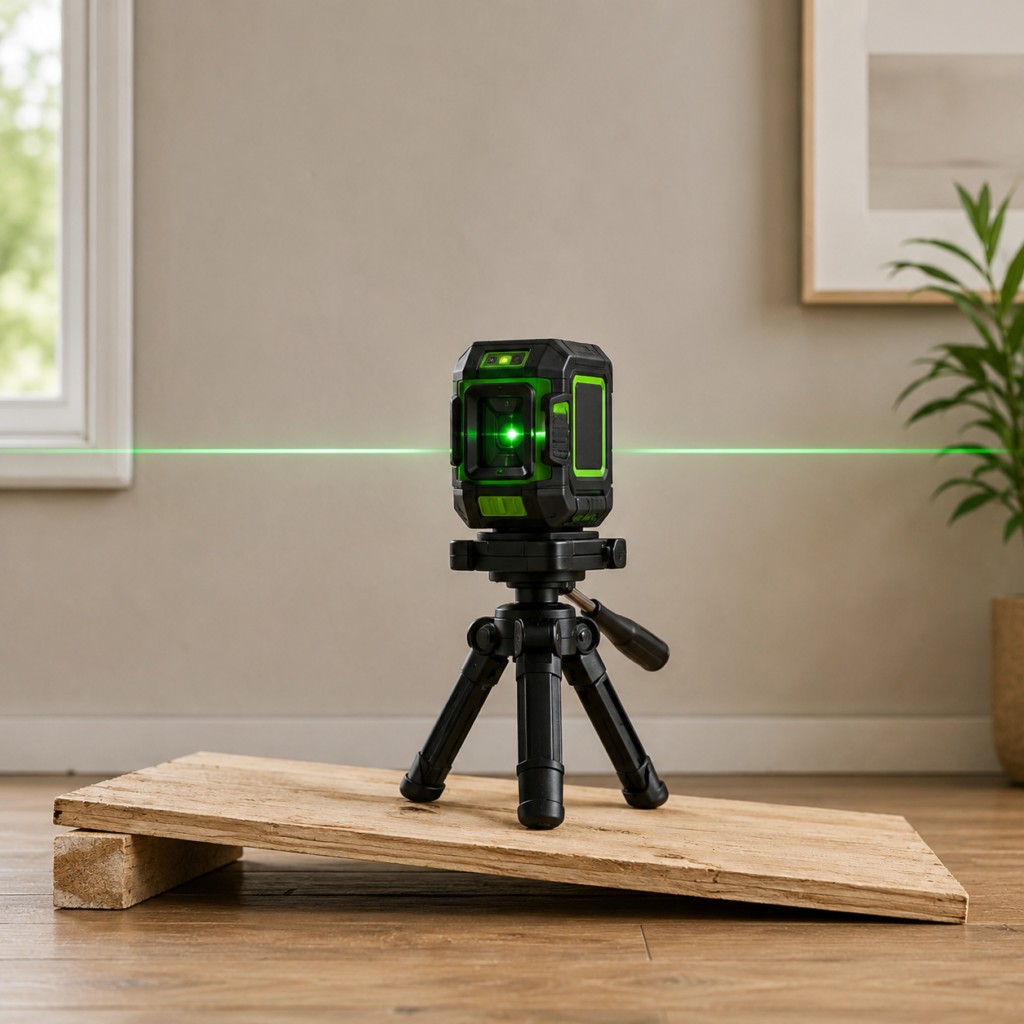
Even if you place the laser on a surface that’s slightly uneven (like in the picture above), the tool automatically adjusts itself and projects a perfectly level line.
That means:
- No fiddling with tiny adjustment knobs.
- No second-guessing if it’s straight.
- Faster setup, so you can get on with your project.
For most DIY jobs around the house, it’s one of those features that saves time and a lot of frustration.
My tip: If you’re buying your first laser level, spend the little bit extra to get one with self-levelling. You’ll thank yourself every time you use it.
💡 Did you know? Most self-levelling laser levels only work within a small angle (usually around 3–4°). If they’re tilted too much, they’ll flash or beep to let you know they can’t level themselves. It’s a handy feature that stops you accidentally working with an inaccurate line.
Red vs Green Laser
When I first started looking at laser levels, I honestly thought the only difference was the colour.
Turns out, there’s a little more to it than that.
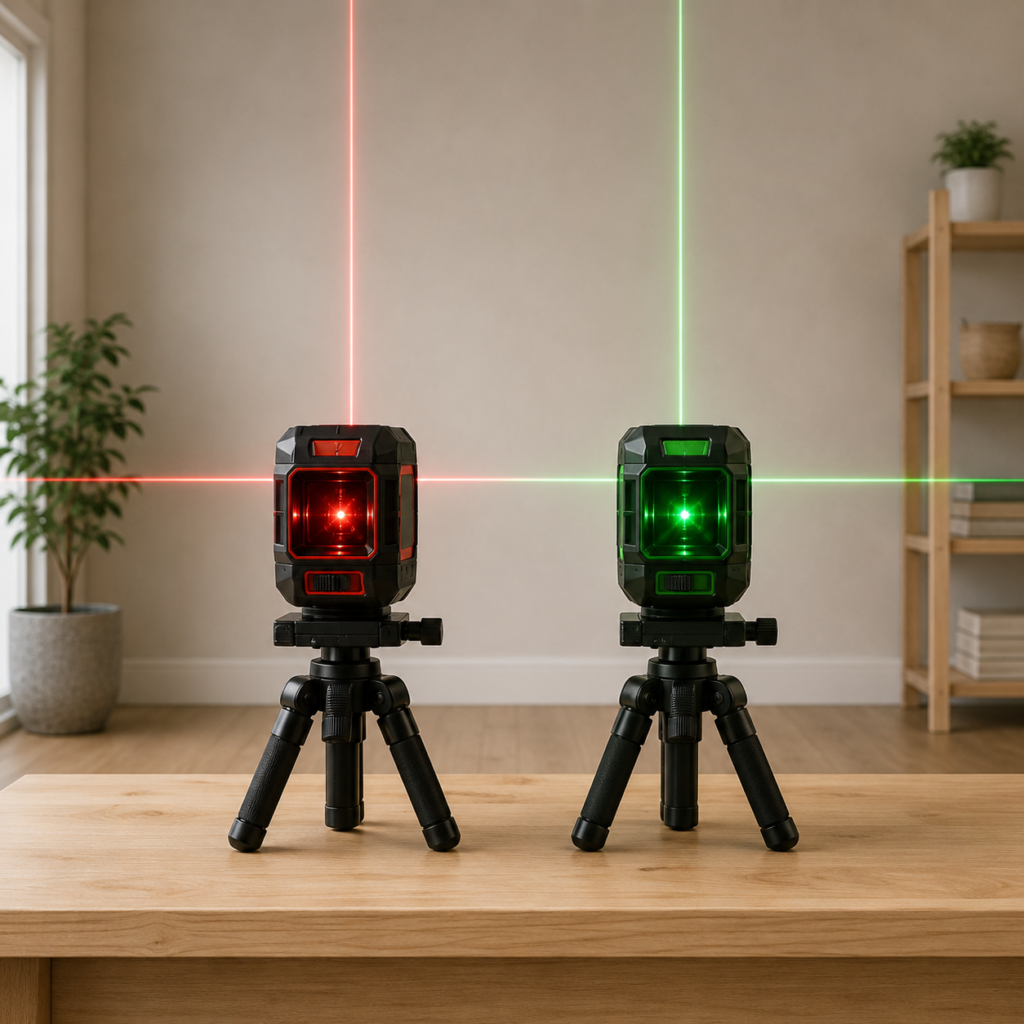
A green laser is much brighter and easier to see, especially if you’re working in a room with lots of natural light or outside on a sunny day. That’s why many professionals choose green—it stays visible from much further away.
A red laser, on the other hand, is usually more affordable and works perfectly well for most indoor DIY jobs. If you’re hanging shelves, putting up pictures or fitting kitchen cabinets inside your home, a red laser will usually do everything you need.
So, which one should you choose?
🏠 Choose a red laser if:
- You mainly work indoors.
- You’re on a budget.
- You’ll only use it for occasional DIY projects.
🌿 Choose a green laser if:
- You have bright rooms with lots of windows.
- You’ll be working outdoors.
- You want the easiest laser line to see.
My tip: If this is your first laser level and you’re only planning to use it around the house, a good-quality red laser is usually all you need. But if your budget stretches a little further, I’d go for green—once you’ve used one, it’s hard to go back.
360° Laser
If you’re planning more than just hanging the odd picture, a 360° laser is definitely worth considering.
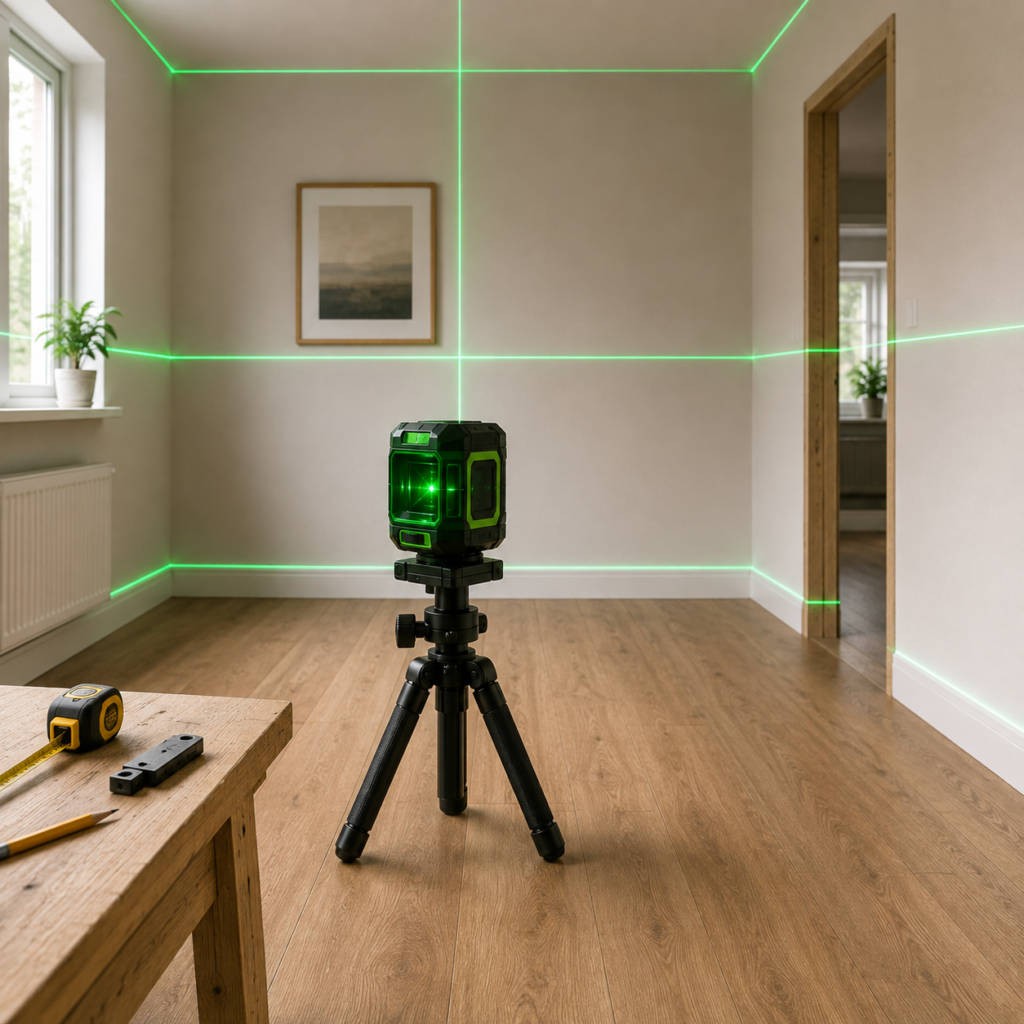
Unlike a standard cross-line laser that only projects one line at a time, a 360° laser projects a continuous level line around the entire room. That means you can see the same level line on every wall without moving the laser.
It might not sound like a big deal at first, but once you’re fitting kitchen cabinets, laying laminate flooring or tiling a bathroom, it saves a huge amount of time.
A 360° laser is perfect for:
- 🏡 Laying laminate or vinyl flooring
- 🍽️ Installing kitchen cabinets
- 🛁 Tiling bathrooms and splashbacks
- 🖼️ Creating gallery walls
- 🛠️ Building stud walls
- 📏 Installing dado or picture rails
Instead of constantly repositioning the laser and checking your measurements, you set it up once and get to work.
My tip: If you’re renovating an entire room or planning several DIY projects, I’d spend the extra money on a 360° laser. It’s one of those tools that makes every job quicker, easier and much more accurate.
Accessories Worth Buying
Buying a laser level is only half the job. These accessories make it much easier to use.
Tripod
Trying to balance a laser level on a paint tin isn’t ideal (yes… we’ve all improvised). A tripod lets you position the laser exactly where you need it.
Bosch BT 150 Tripod – sturdy, adjustable, and compatible with many Bosch laser levels.
Measuring Tape
You’ll still need one. Look for a sturdy 5m or 8m tape with an easy-lock mechanism.
Stanley FatMax 5m Tape Measure – One of the most popular tape measures for DIY and professional use.
Laser Enhancement Glasses
These don’t make the laser stronger, but they can make the beam much easier to see in bright conditions.
Universal Green Laser Enhancement Glasses
Spare Batteries
There’s nothing more annoying than running out halfway through putting up shelves. Keep a spare set nearby.
Panasonic Eneloop AA Rechargeable Batteries -They’re reliable, reusable, and cheaper in the long run than disposable batteries.
View on Amazon
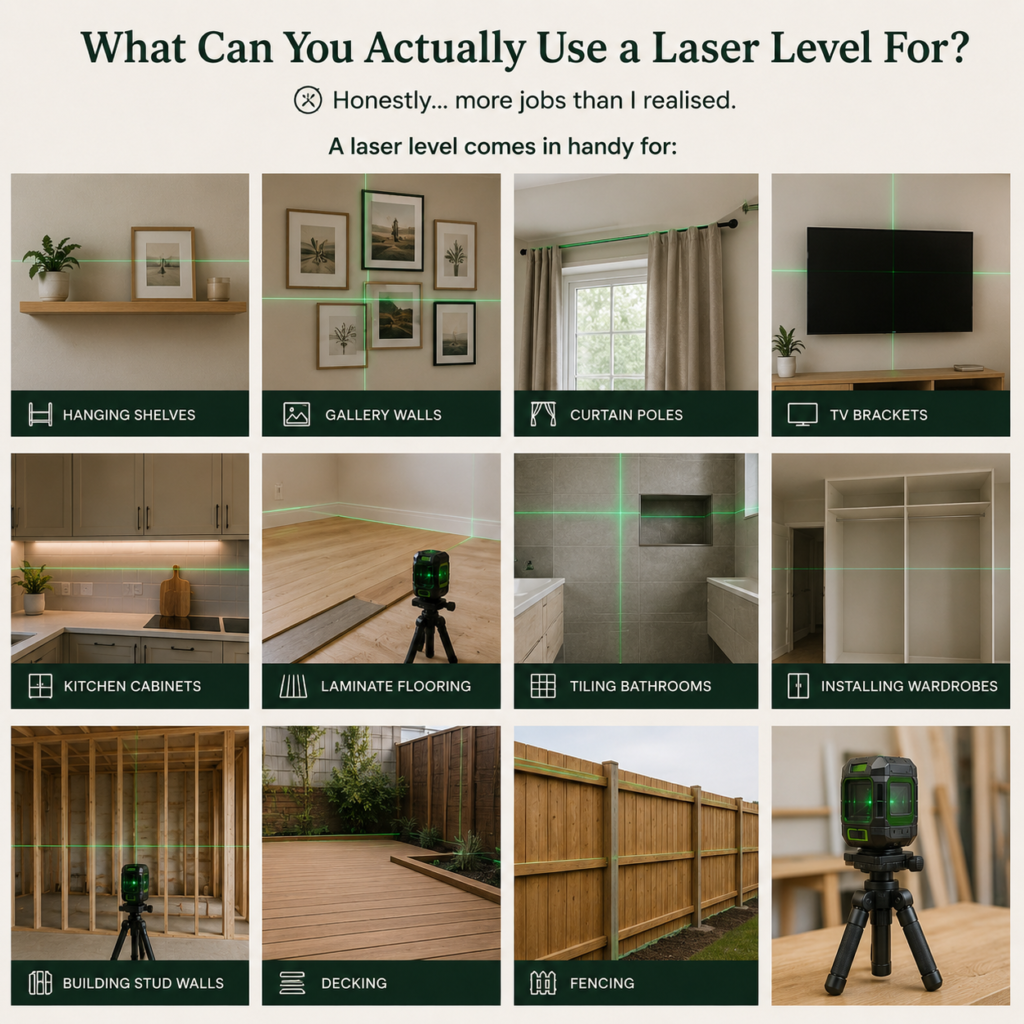
Are Laser Levels Worth It? (An Honest Answer From Someone Who Almost Didn’t Buy One)
Short answer: yes. Slightly longer answer: yes, but only once you stop hanging shelves by “eyeballing it” and accept that your eyeballs have been lying to you the whole time.
I put off buying a laser level for way longer than I should have. It felt like one of those tools — like a stud finder, or a proper tool belt — that “real” DIYers had and amateurs like me didn’t need yet. Turns out that’s backwards. A laser level isn’t a professional’s tool. It’s an amateur’s best friend, because it does the one thing your eyes, your bubble level, and your unshakeable confidence cannot: it tells you the truth.
So What Does “Worth It” Actually Mean Here?
It means: does this thing save you more time, materials, and dignity than it costs? For most first-time DIYers tackling shelves, art walls, curtain rods, tile, or basically anything that needs to line up in a straight line, the answer is a confident yes. Here’s the math nobody tells you:
- One re-drilled hole in the wrong spot costs you spackle, paint, and a Tuesday evening.
- One crooked gallery wall costs you having to explain to guests that it’s “intentionally asymmetrical.”
- One laser level costs about the same as a decent bottle of wine and saves you from both of the above, repeatedly, forever.
If you’re doing a single, one-and-done project, sure — borrow one or just be very patient with a spirit level and a lot of swearing. But if DIY is becoming a Thing You Do (and if you’re here, it probably is), a laser level pays for itself embarrassingly fast.
What About the Cheap Ones — Are They Actually Any Good?
This is the real question hiding under “are laser levels worth it,” and it deserves a real answer: it depends what you’re levelling.
- Hanging a shelf, mirror, or art? A budget line laser is genuinely fine. You need a straight reference line indoors, in a room with normal light. That’s it.
- Working outside, in bright sun, or over long distances? Budget lasers get washed out and hard to see. This is where spending more actually buys you something real — brightness — not just brand snobbery.
- Tiling, cabinetry, or anything that needs both a level and plumb line at once? Look for a cross-line (self-levelling) model. It’s the best laser level for DIY use across the widest range of projects, because it does two jobs at once.
The best laser level for home use isn’t the most expensive one on the shelf — it’s the cheapest one that’s still bright enough to see clearly in the room you’ll actually be using it in.
“But I’ll Definitely Mess It Up” — No You Won’t
I promise the tool is more competent than the anxiety spiral tells you it is. You press a button, it projects a straight line, you follow the straight line. That’s genuinely most of it. The only real rule: don’t drop it. These things are surprisingly delicate for something that shoots a laser — a hard knock can throw the calibration off, and then you’re back to square one, except now you distrust your tool, which is somehow worse than not having one.
Quick-Fire FAQ
Is a laser level worth it for a one-time project? Honestly, maybe not — renting or borrowing one is fine for a single job. It earns its keep once you’ve got two or more projects lined up.
What’s the best value laser level for a beginner? A basic self-leveling line laser, red beam, indoor use. Skip the green beam and the tripod kit until you actually need outdoor visibility — that’s where the price jumps for a feature you may never use.
Do I need the 360-degree version? Only if you’re leveling a whole room at once — think laying flooring or hanging a run of cabinets along multiple walls. For single-wall projects, a standard line laser does the job for less.
What’s the single biggest beginner mistake? Not checking the laser is actually level before you start. Most self-levelling models beep or flash when they’re outside their levelling range — don’t ignore that warning because you’re excited to get drilling. (Ask me how I know.)
Still deciding which one to buy? Our full laser level buying guide breaks down every type, price point, and feature so you don’t have to learn the hard way — as I did.
Final Thoughts
A laser level isn’t one of those gadgets you’ll use once and forget about.
Whether you’re putting up a single shelf or renovating an entire room, it’s one of those tools that quietly makes every job easier.
If I had to recommend just one, the Bosch UniversalLevel 360 is the best all-round choice for most homeowners. It’s accurate, reliable, easy to use, and offers excellent value for money.
If you’re on a tighter budget, there are still some fantastic options that will do the job without breaking the bank.
No matter which one you choose, one thing’s for sure—you’ll spend a lot less time measuring twice… and a lot less time taking shelves back down because they’re somehow still crooked.
In conclusion, investing in a laser level is like hiring a professional assistant who never takes a coffee break. You’ll find yourself wondering how you ever managed without one, as it brings precision and efficiency to your DIY projects. Plus, with the range of options available, you can find a model that suits both your needs and your budget. So go ahead, level up your home improvement game—your shelves will thank you!
Redecorating your bathroom next? Read this first → Before you call a plumber, check out Budget Bathroom Refresh: 15 Ways to Update Your Bathroom Without a Full Reno — small swaps, zero renovation, still looks brand new by Sunday.